



You’ve probably seen them all over social media lately. Black with white spots. Bright red wings when they fly. Jumping instead of flying away. Spotted lanternflies have officially made themselves at home in southwest Ohio, and while they’re certainly a nuisance, there’s a lot of misinformation about what they actually do.
Let’s separate the facts from the fear.
What exactly is a spotted lanternfly?
Despite their name, they aren’t great fliers. They’re actually planthoppers that spend most of their time hopping, climbing, and feeding on plants. They use a needle-like mouthpart to pierce stems and trunks and drink sap from plants.
One insect isn’t much of a problem. Thousands feeding together are. When populations become large, they slowly weaken plants by removing water and nutrients.
Which plants are at risk?
One thing surprises people: Spotted lanternflies don’t eat leaves. They feed on the trunks, branches, and stems of woody plants.
Their favorites include:
Highest Risk
- Grapevines
- Tree of Heaven (their favorite host)
Common Landscape Trees
-
Maple
-
River Birch
-
Black Walnut
-
Willow
-
Sycamore
Fruit Trees
-
Apple
-
Peach
-
Cherry
-
Plum
They’ve been found feeding on more than 100 different plant species, but they clearly prefer certain hosts.
Will they kill my tree?
Usually…no. A healthy mature maple or oak is unlikely to die from spotted lanternflies alone. Instead they cause stress. Heavy infestations can:
- reduce plant vigor
- slow growth
- weaken young trees
- reduce grape production
- make plants more susceptible to drought and disease
Grapevines are where the greatest economic damage occurs. Vineyards can lose significant crops if infestations aren’t controlled.
What’s all the sticky mess?
One of the biggest complaints isn’t actually the insect. It’s what they leave behind. As lanternflies feed, they excrete a sugary liquid called honeydew. Honeydew can coat:
-
leaves
-
patios
-
decks
-
outdoor furniture
-
grills
-
cars
-
sidewalks
Then a black fungus called sooty mold grows on the sticky coating. The mold usually doesn’t infect the plant itself, but it blocks sunlight on leaves and creates a messy black film that homeowners hate.
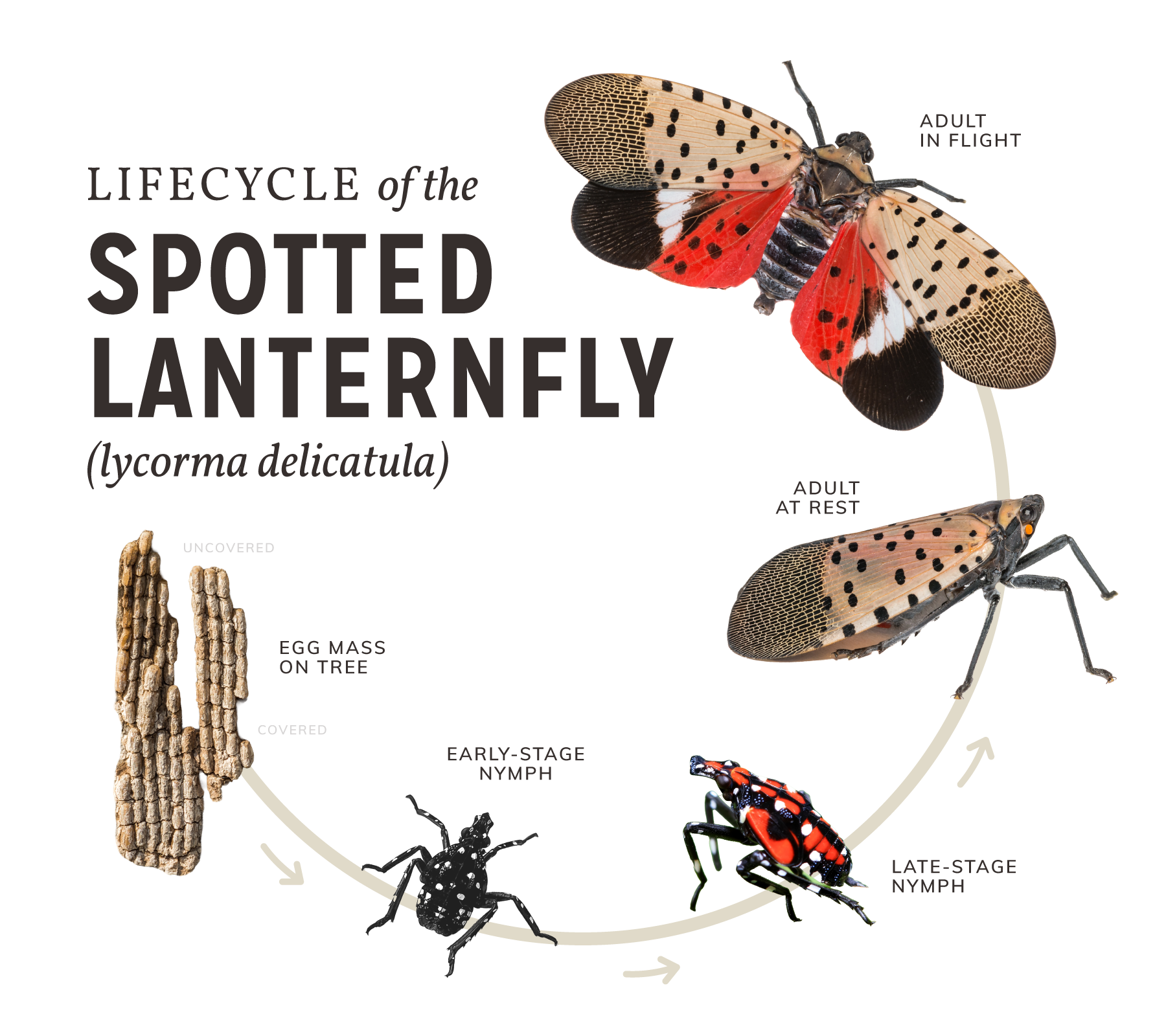
Their life cycle
Understanding when they appear makes controlling them much easier.
Spring
Egg masses hatch.
Tiny black nymphs with bright white spots emerge.
These are easiest to kill.
Early Summer
The nymphs grow larger.
They’re still black with white spots but become much more active.
Mid to Late Summer
The nymphs turn brilliant red with black and white markings.
This is usually when people first notice them.
Late Summer into Fall
Adults appear.
Gray wings with black spots.
Bright red hind wings when opened.
Adults mate and begin laying egg masses that survive the winter.
Should you kill them?
Yes. Ohio encourages homeowners to kill spotted lanternflies whenever practical. Stepping on them is perfectly acceptable. They’re invasive and have very few natural predators here.
How do you control them?
The best method depends on the time of year.
Egg masses (Fall through Winter)
Scrape them into rubbing alcohol or hand sanitizer.
Each egg mass can contain 30-50 future lanternflies.
Nymphs (Spring & Early Summer)
These are much easier to control than adults.
- Insecticidal soap
- Neem oil
- Pyrethrin products
- Direct contact insecticides
Adults (Late Summer)
Adults are tougher.
Options include:
- Direct contact insecticides
- Systemic insecticides on valuable host trees (when appropriate)
- Traps designed specifically for lanternflies
Always follow label directions and avoid spraying blooming plants where pollinators are active.
Should every homeowner spray?
Not necessarily. If you only see a handful each week, spraying probably isn’t worth it. If you have dozens or hundreds gathering on a favorite tree every day, especially grapes or young trees, treatment may be worthwhile.


 @whiteoakgardens